
Beyond Automation
Author: Bhupesh Mangla, Program Manager – Quality & Operations at EWANDZ
“The future of business operations isn't about doing more work. It's about making better decisions—with intelligence built into every process.”
Over the past two decades, organizations have invested billions in digitization and automation to improve efficiency and reduce operational costs. While automation has transformed repetitive work, today's competitive advantage no longer comes from simply executing processes faster—it comes from making better decisions. Artificial Intelligence is now enabling organizations to move beyond automation by embedding intelligence into everyday operations, allowing people and systems to learn, predict, and continuously improve.
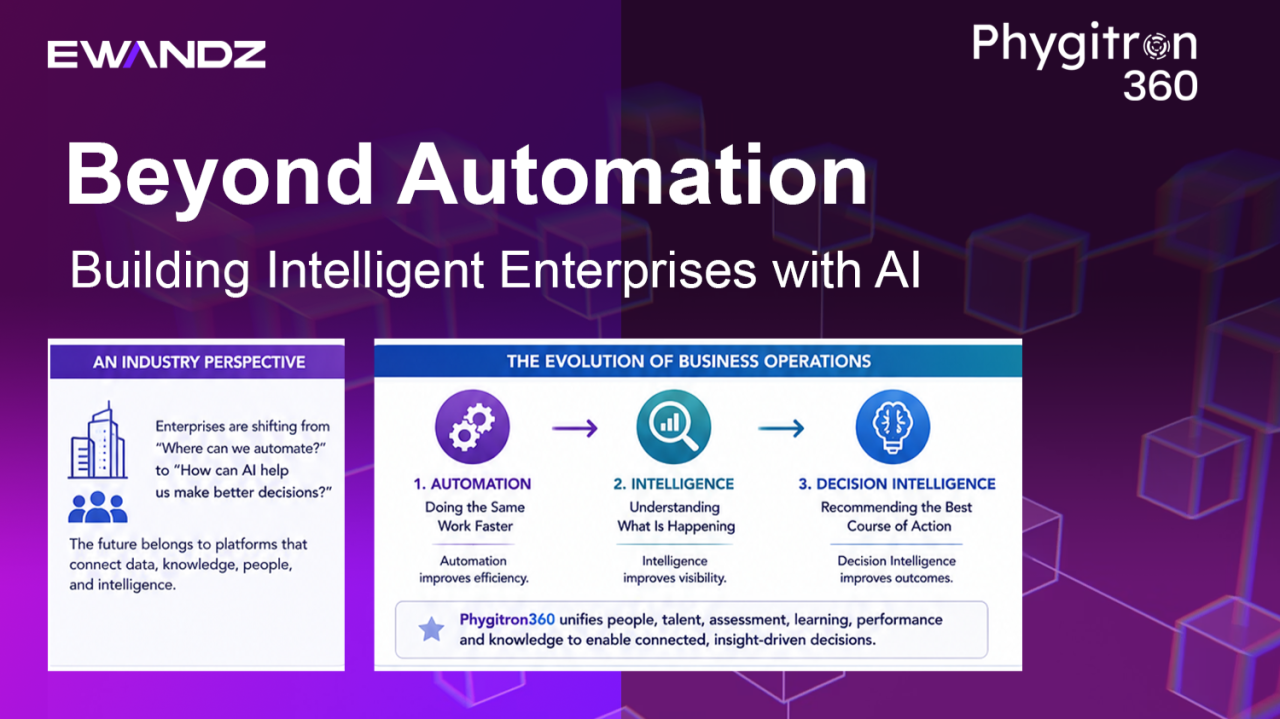
This shift marks a fundamental transformation in how businesses operate. We are moving beyond automation into an era of intelligence—and increasingly, decision intelligence—where technology not only executes processes but also enables organizations to make faster, smarter, and more informed business decisions.
This transformation is also reshaping one of an organization's most valuable assets — its people and their knowledge.
AI-powered platforms such as Phygitron360 show how organizations can embed intelligence across the employee lifecycle, connecting talent, assessments, learning, performance, and organizational knowledge to drive more informed workforce decisions.
An Industry Perspective
At EWANDZ, we work with organizations across technology, cybersecurity, learning, knowledge management, and digital operations. One trend has become increasingly clear businesses are no longer asking "Where can we automate?" They are asking "How can AI help us make better decisions?" This shift is redefining enterprise operations and creating demand for platforms that connect data, knowledge, people, and intelligence across the organization.
The Evolution of Business Operations
The evolution of business operations can be viewed as a journey through three distinct stages—Automation, Intelligence, and Decision Intelligence.
1. Automation – Doing the Same Work Faster
Automation answered a simple but important question: "Can this task be automated?"
“Automation improves efficiency.”
In workforce operations, this could mean digitizing employee processes, automating assessments, or streamlining learning and talent-management workflows.
2. Intelligence – Understanding What Is Happening
Then, organizations began asking: "What is happening, and why?"
“Intelligence improves visibility.”
For example, a platform like Phygitron360 can unify insights from employee data, assessments, learning, talent, and knowledge — giving organizations a more holistic view of workforce capabilities and development needs.
3. Decision Intelligence – Recommending the Best Course of Action
The Decision Intelligence shifts the conversation to: "What should we do next?"
“Decision Intelligence improves business outcomes and empowers business leaders with AI-driven recommendation.”
This is the direction intelligent platforms like Phygitron360 can take workforce operations — from managing isolated HR and learning processes to enabling connected, insight-driven decisions.
How AI Is Transforming Business Operations
AI is no longer limited to a single department. It is transforming operations across the enterprise by augmenting people with intelligent insights and automation.
1. Human Resources (HR): AI streamlines talent acquisition, resume screening, skill assessments, personalized learning, and workforce trend analysis — enabling data-driven talent decisions.
Platforms like Phygitron360 extend this by connecting the employee lifecycle end-to-end: employee data, talent management, assessments, learning, performance, and knowledge — creating a continuous intelligence loop:

2. Finance: AI automates invoice processing, expense management, fraud detection, financial forecasting, cash flow analysis, and risk management, enabling faster and more accurate financial decisions.
3. Supply Chain: AI improves demand forecasting, inventory optimization, logistics planning, warehouse operations, route optimization, and disruption prediction to build more resilient supply chains.
4. Customer ServiceAI: virtual assistants, chatbots, sentiment analysis, and intelligent case routing deliver faster response times, personalized support, and improved customer experiences.
5. Procurement: AI automates supplier evaluation, contract analysis, spend analytics, purchase approvals, and sourcing decisions while identifying supplier risks and cost-saving opportunities.
6. Manufacturing: AI enables predictive maintenance, visual quality inspection, production planning, process optimization, robotics, and real-time monitoring to improve productivity and reduce downtime.
7. Marketing: AI personalizes customer experiences, segments audiences, predicts customer behavior, generates content, optimizes campaigns, and provides real-time marketing insights.
8. IT Operations (AIOps): AI continuously monitors infrastructure, predicts failures, automates incident resolution, detects security threats, optimizes cloud resources, and improves overall IT reliability.
Beyond Technology: The Real Business Impact
While AI is transforming processes across every business function, sustainable transformation ultimately depends on an organization’s ability to build the right skills, knowledge, capabilities, and talent.
This is where the concept behind Phygitron360 becomes particularly relevant. Instead of viewing various processes as separate systems, it connects them through a unified intelligence layer.
The result is a shift from fragmented workforce processes toward a more connected model.
Know Your People à Understand Their Capabilities à Identify Gaps a Develop Skills à Enable Performance à Make Better Decisions
This represents the broader vision of Phygitron360—using AI not simply to automate workforce processes, but to build a connected ecosystem where people, talent, learning, assessment, performance, and knowledge continuously inform better decisions.
Organizations that successfully embrace Intelligent Operations can make faster, evidence-based decisions, improve operational efficiency, predict risks before they become business problems, and deliver better customer and employee experiences.
In short, AI is shifting business operations from reactive to predictive and proactive.
Leadership Perspective
The future of leadership won't be defined by how much work AI can automate, but by how effectively leaders use AI to make better decisions.
Technology can process data at unprecedented speed — but only people can provide context, exercise judgment, inspire teams, and take accountability.
In an AI-driven world, the greatest competitive advantage won't be AI alone — it will be leaders who know how to combine it with human expertise.
Platforms like Phygitron360 can give leaders connected insights across people, skills, learning, talent, and organizational knowledge. But the real value emerges when leaders translate those insights into decisions — who to hire, what skills to build, where to invest in learning, how to develop talent, and how to prepare the workforce for the future.
The Road Ahead
The journey from Automation to Decision Intelligence has already begun.
The next frontier isn’t about deploying more AI tools—it is connecting intelligence across the organization so that data becomes insight, insight drives action, and action creates measurable business impact.
Phygitron360 represents this vision in the context of people and organizational capability—bringing together employee, talent, assessment, learning, performance, and knowledge intelligence to help organizations move from managing processes to enabling smarter decisions.
“Connecting people, knowledge, and intelligence to power better decisions.”

Bhupesh Mangla
is a Program Manager – Quality & Operations at EWANDZ with years of experience in quality, operational excellence, digital learning, and technology-driven transformation. Passionate about AI-enabled operations and data-driven decision-making, he leads and collaborates with the team behind Phygitron360, an AI-powered platform that enables smarter workforce decisions and shapes the future of work